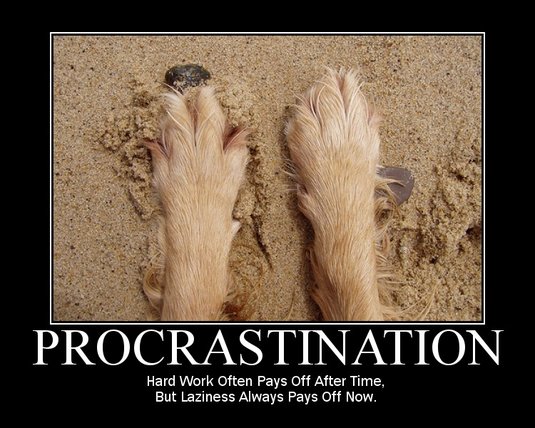
Psychologists say it’s not a time management problem. So what’s going on?
My college memories rapidly faded after graduation, but one of my most vivid, enduring memories is of one of my former roommates, who was a chronic procrastinator. Sure, he waited until the last minute on take-home tests, 10-page papers and studying. But my absolute favorite was the night before move-out. It was around 1 AM, and we had to be out of our dorm by 12 PM the next day. The roommate had just popped open a bottle of some form of alcohol and hadn’t even begun packing. My other roommates and I looked at each other in disbelief and reminded him that we had to move out in mere hours. His response: “I figure I have 11 hours to pack. That’s plenty of time!” I’m pretty sure that, like most mortals, he fell asleep somewhere around 4, and no, he did not make it out of the room on time.
Turns out my old roommate suffered from one of the most common side-effects and/or causes of procrastination: optimism. That is, he underestimated how long it would take him to pack and overestimated his ability to stay awake all night after drinking.
There are lots of psychological hang-ups and side effects that lead us to procrastinate (and probably to put off all those things that would improve your financial situation a ton). Here are a few of them.
You know that exercise where you “picture” where you want to be? That’s B.S.
Or, at least, so says a study published a couple years ago in Psychological Science.
You’ve probably been told to do this exercise dozens of times in self-help books. Envision who you want to be. Put pictures of people at the right weight up on the bulletin board. See yourself scoring the goal at the big game. Imagine that letter informing you of your perfect GMAT score.
But thinking in abstractions like that apparently leads us to procrastinate from doing the actual exercises, practice, and studying needed to achieve those goals. To prove that, the scientists mailed subjects two questionnaires. In one version, they led the questions with a full picture of La Parade, by Georges-Pierre Seurat, and described the painting as “a good example of neo-impressionism in which the artist was using order and colour to invoke emotion and harmony.” The second group of respondents got a small detail of a portion of the painting, and were told “this demonstrated the pointillist technique of using contrasting points of colour to build up an image.” In other words, the first spoke to the emotions and abstraction of the piece, while the second spoke to the actual methods Seurat used to paint it.
The survey had a bunch of questions, but the researchers were really only interested in how long it took each set of respondents to return the survey (they were asked to give it back in three weeks). The results were definitive. Those given the whole painting and abstract description took 20.5 days to return the questionnaire, while those given the detail returned it in 12.5 days.
The message that the researchers concluded for procrastinators was simple: Focus on the details. Creating a list of little, specific tasks—like to complete one practice test on Wednesday and sign up for a Kaplan course on Thursday—is much more effective than simply putting a picture of Harvard Business School on your desk.
It helps to set a self-imposed deadline. It helps more if someone else sets it for you.
I go into and out of phases where I create lists of tasks that I plan to accomplish the next day. Invariably, the list is extremely effective for the first few days that I use it. Then one or two tasks will slip to subsequent days. And then the whole system will fall apart, and I’ll stop making lists for a few months.
It turns out that my pattern isn’t unique. Procrastinators do benefit from making self-imposed deadlines to accomplish certain items—at least, they do better than if they don’t set the deadlines at all, according to researchers. But, predictably, when it’s only ourselves we have to disappoint, we don’t perform as well.
I’ve thought about signing up for Stickk.com for a while, which was founded by a couple Yale professors. The website basically lets you set up a monstrous (or not-so-monstrous) incentive to stick to a goal. For me, it might be something like “Write two blog posts per week for PopEconomics.com”. If I hit it, nothing happens. If I don’t, some sizable monetary penalty hits my credit card and is donated to charity or to whatever third-party referee I designate. To motivate myself, I think I’d have to set a penalty of at least $1,000. Probably more. Dangerous? Yes. Possible to spur dangerously high productivity? I hope so.
The three basic types of procrastinators
This didn’t come from an economic study, but from a pair of psychologists writing for Psychology Today. It’s probably based on some study or another, but I can’t find it offhand. Still, its assertions are intriguing.
It turns out that we procrastinate for three, basic reasons: because we want the euphoric rush of performing on deadline, because we hate failure, and because we have trouble making decisions. If anything, I think I suffer from the second problem. No attempt, no possibility of failure. Though I notice I’ve become better at that as I’ve gotten older. I definitely don’t procrastinate because I “like” panicking and working like mad as a serious deadline approaches. And while I have trouble making decisions sometimes, often I think I don’t begin a task because I don’t understand or take the time to break down all of the steps needed to complete that task (see the second heading).
Anyway, you can thank that inability to make a decision for this morning’s post, which I am writing past midnight on a work day. And I am happy to say that I’ve just started making “To-Do” lists again. Let’s see how long this lasts.
I was remiss in not mentioning earlier that this post was featured in the Carnival of Personal Finance at Suburban Dollar. Thanks Kyle!




{ 491 comments… read them below or add one }
← Previous Comments
So many great insights packed into one post.
This is exactly the kind of excitement I love to read!
You’ve done an amazing job explaining this.
There’s real magic in the way you write — amazing job!
I feel more informed after reading this.
I’m honestly speechless — this is THAT good!
Such a lively, powerful burst of content — awesome!
I appreciate how practical and actionable your content is.
I felt the excitement building as I read — fantastic job!
Your writing is always so thoughtful and authentic.
I’m blown away by the value in this post.
This post is bursting with brilliance — wow!
This was insightful and beautifully written.
You’re such a vibrant writer — this was amazing!
This content POPS — amazing job!
Hands down one of the best things I’ve read all week!
Seriously HIGH-VIBRATION content — amazing job!
This is the kind of content that keeps me coming back.
Your ability to explain things simply is such a gift.
Another excellent post — you never disappoint!
This was helpful, inspiring, and beautifully written.
Your writing is pure inspiration — so beautifully enthusiastic!
What a refreshing perspective — I really enjoyed reading this.
You’ve set the bar incredibly high — WOW!
I appreciate how practical and helpful this post is.
Your dedication to quality really shows here.
This was beautifully written and easy to follow.
You approach topics with such grace and intelligence.
You have a natural gift for teaching through writing.
I’m genuinely hyped after reading this — incredible!
Your energy is absolutely infectious — love it!
Your writing is a powerhouse of enthusiasm — great job!
Your content is always a breath of fresh air.
This made my day — thank you for sharing!
I’m walking away energized — thank you for this amazing content!
Thank you for putting so much effort into your work.
This post is absolutely glowing with passion!
This is the kind of content people rave about — amazing!
This was insightful and beautifully written.
Absolutely electric writing — very impressive!
This was both insightful and enjoyable — perfect combination.
You’re on FIRE with content like this — amazing job!
I’m absolutely loving the vibe here — great work!
You make complicated concepts feel effortless.
The quality of your writing is outstanding.
Your writing style is so clear and engaging. Loved this!
Great insights — thank you for the clarity!
This was such an electrifying read — awesome job!
Your writing is pure inspiration — so beautifully enthusiastic!
I love how clear and comprehensive your posts are.
← Previous Comments
{ 3 trackbacks }